Chapter 3: The Silicone Cell
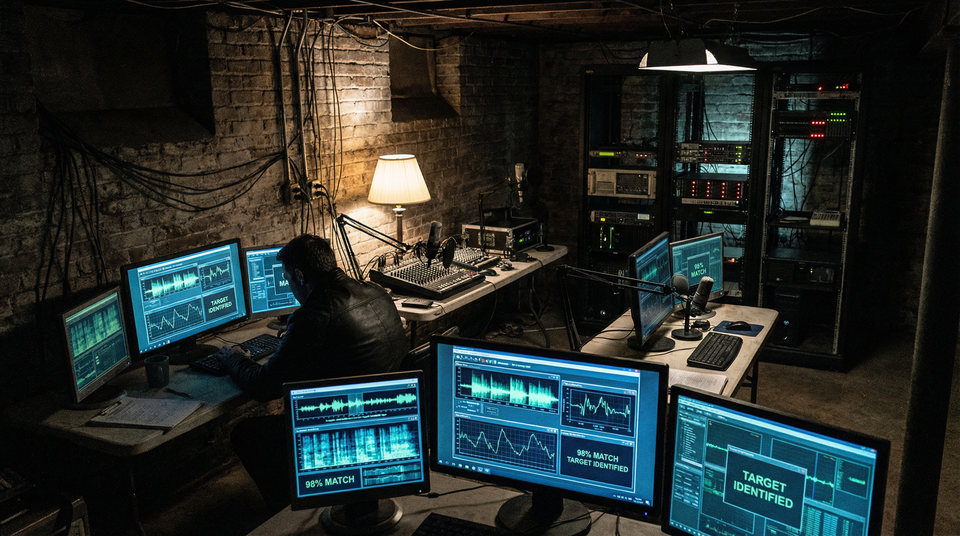
Twelve miles away, in the basement of a nondescript literacy center in Alexandria, Virginia, Dr. Aris Thorne sat before a wall of monitors and listened to the voice of the President of the United States say words he had never spoken.
The literacy center occupied the ground floor of a two-story brick building on a residential street where the houses had American flags on their porches and minivans in their driveways. It was called the Alexandria Community Literacy Project, and during daytime hours it functioned exactly as advertised—volunteer tutors helping adults learn to read, ESL classes on Tuesday and Thursday evenings, a small lending library stocked with donated paperbacks. The director was a retired schoolteacher named Margaret Huang who believed passionately in the power of education and who had no idea that the basement of her building contained enough computing power to rival a small intelligence agency.
The basement was accessed through a door behind the supply closet, secured with a biometric lock disguised as an electrical panel. Aris had installed it herself, along with the fiber optic line that ran through the building's plumbing conduit to a junction box three blocks away, where it connected to a commercial internet backbone through a series of anonymizing relays that made the traffic appear to originate from a data center in northern Virginia. The basement itself was roughly eight hundred square feet—low-ceilinged, climate-controlled to a precise sixty-four degrees by a whisper-quiet HVAC system, and lined on three walls with server racks, monitor arrays, and the kind of cabling infrastructure that would make a network engineer weep with either admiration or horror, depending on their tolerance for improvisation.
This was the Silicon Cell. It had no official name—the Tuesday Literary Society avoided naming things whenever possible, on the principle that a name was a handle and a handle could be grasped—but Aris had begun calling it that in her own mind, and the name had stuck. It was where the digital architecture of the operation lived: the voice models, the biometric intercept protocols, the communications infrastructure that would, in a few hours, allow a handful of women to impersonate the President of the United States to the most sophisticated military apparatus on the planet.
Aris leaned back in her chair and stretched her neck, feeling the vertebrae pop in a sequence that had become disturbingly familiar over the past six months. She was fifty-three years old, lean and angular, with close-cropped silver hair and the kind of face that revealed nothing unless she wanted it to. Before the Hale administration, she had spent twenty-two years at the National Security Agency—first as a cryptanalyst, then as a senior researcher in the signals intelligence division, and finally as the deputy director of a unit so classified that its budget was hidden inside the line item for Pentagon cafeteria supplies. She had been good at her job. She had been exceptional, in fact, which was precisely why the administration had retired her.
The official reason was a "restructuring of senior technical positions." The actual reason was that Aris had written a memorandum—classified, internal, distributed to exactly four people—questioning the constitutional implications of the Patriot Protocol, the administration's new centralized communications system that gave the White House direct, real-time access to every federal law enforcement and military communications network in the country. The memorandum had been measured, technical, and scrupulously apolitical. It had pointed out that the Protocol's architecture created a single point of failure that, if exploited, could compromise the entire national security apparatus. It had recommended distributed redundancy as a corrective measure.
Within seventy-two hours of the memorandum's distribution, Aris had been called into the office of the NSA director—a political appointee with no technical background who had been installed to ensure ideological compliance—and informed that her services were no longer required. Her security clearance had been revoked. Her access to classified systems had been terminated. Her name had been added to a watchlist that prevented her from seeking employment at any federal agency or defense contractor. She had been, in the language of the intelligence community, "burned."
What the administration had not done—because the administration, like all authoritarian regimes, suffered from the fatal assumption that compliance could only be extracted through employment—was erase what she knew. And what Aris Thorne knew, after twenty-two years at the heart of America's signals intelligence apparatus, was everything.
She knew the architecture of the Patriot Protocol because she had reviewed its design documents before they were classified above her clearance level. She knew the encryption schemas used by the Presidential Life-Line system because she had consulted on their development. She knew the biometric authentication protocols that governed access to the Situation Room, the nuclear football, and the secure communications links between the White House and the Pentagon. And she knew—because she had spent twenty-two years studying the ways that complex systems failed—exactly how to make all of it fail simultaneously.
The memorandum had been right. The Patriot Protocol was a fortress built on a single-point-of-failure architecture. The administration had wanted total control. Aris was going to give it to them.
Beside her, Chloe Vance was typing with a rhythmic, aggressive speed that Aris found simultaneously impressive and slightly alarming. Chloe was twenty-seven years old, a Georgetown computer science graduate who had been recruited by the Tuesday Literary Society through Commander Sarah Vance—her older sister, a connection that Aris had initially viewed with suspicion but had come to regard as one of the operation's greatest assets. Where Aris was methodical and architectural in her thinking, Chloe was improvisational, a hacker in the purest sense of the word—someone who saw systems not as structures to be understood but as puzzles to be solved by any means necessary.
Chloe's workstation was a controlled chaos of open terminals, scrolling code, and empty cans of an energy drink called Voltage that Aris privately believed was more marketing than caffeine. She wore headphones around her neck—enormous, noise-canceling—and a t-shirt from a cybersecurity conference that read "I VOID WARRANTIES" in block letters. Her dark hair was pulled back in a knot secured with what appeared to be a USB cable. She was, in Aris's assessment, brilliant, reckless, and exactly the kind of person you wanted on your side when you were trying to deceive the Pentagon.
"The Patriot Protocol is active," Chloe said, not looking up from her screen. Her fingers continued their assault on the keyboard as she talked—a multitasking ability that Aris had learned to stop finding disconcerting. "Full network integration went live at twenty-one hundred. All federal law enforcement, all military branches, all Heritage Unit comms—everything is running through the centralized node. The administration's new centralized comms system is a fortress, but it's built on a single-point-of-failure architecture. They wanted total control. We're going to give it to them."
She said the last sentence with a smile that Aris recognized as the particular satisfaction of someone who had found an elegant exploit. Chloe had spent four months mapping the Patriot Protocol's network topology, identifying the specific relay points where the centralized architecture created vulnerabilities. The result was what she called a "ghost layer"—a set of intercept protocols that could sit between the White House and the Pentagon, capturing and modifying communications in real time without triggering any of the system's integrity checks. It was, in technical terms, a man-in-the-middle attack executed at the level of national infrastructure. It was also, Aris reflected, probably the most sophisticated piece of signals intelligence work since Bletchley Park.
"Show me the voice model," Aris said.
Chloe pulled up a waveform on the center monitor—a visual representation of the generative voice model they had spent the past three months building. The model was trained on over four hundred hours of President Calder Hale's recorded speech: press conferences, State of the Union addresses, private calls intercepted by the Tuesday Literary Society's network of inside sources, and—most crucially—the secure line recordings that Diego Soto had extracted from the White House communications archive using a modified USB device disguised as a phone charger.
Aris watched the waveform pulse and ripple on her screen, the peaks and valleys of a voice that could order deployments, invoke emergency powers, and end careers with a sentence. The generative model didn't simply mimic Calder Hale's voice—it replicated the entire architecture of his speech: the cadences, the pauses, the specific way he emphasized certain words, the barely perceptible nasality that crept in when he was giving orders versus the flatter, more deliberate tone he used when he was lying. The model had been refined through hundreds of iterations, each one compared against the source recordings and adjusted with the precision of a master forger matching brushstrokes.
"Test the cadence," Aris said.
Chloe typed a command and the speakers crackled with the President's voice. "General, I want a full readiness report on my desk by zero-seven-hundred. And tell the Heritage Unit commanders in sector four to maintain position until I give the stand-down order. This is not negotiable."
The voice was perfect. Not just the timbre and pitch—those were the easy parts, the surface characteristics that any competent voice synthesizer could approximate—but the rhythm, the weight, the specific way Calder Hale paused between "not" and "negotiable" to let the silence do the work of intimidation. Aris felt a chill that had nothing to do with the climate-controlled air. She was listening to a ghost. A digital specter that would, in a few hours, speak with the full authority of the presidency while the actual President lay unconscious with a spoofed biometric signal feeding the Pentagon false data about his vital signs.
"Accuracy?" Aris asked.
"98.4%," Chloe replied, swiveling her chair to face Aris with the expression of someone presenting a particularly satisfying proof. "The remaining 1.6% is in the extreme registers—if he screams or whispers, the harmonic modeling loses fidelity. But for standard operational communication—phone calls, secure briefings, radio orders—the Pentagon won't know they're talking to a ghost."
"What about duration? How long can we sustain a real-time conversation?"
"Depends on the complexity. For pre-scripted directives—deployment orders, stand-down commands, the kind of things Calder says on autopilot—we can run indefinitely. The model generates in real time and the latency is under two hundred milliseconds, which is within the normal variance for secure line transmission. For interactive conversation—someone asking questions, pushing back, requiring improvised responses—I'd say we're safe for about ninety seconds before a trained ear might start noticing artifacts."
"Ninety seconds," Aris repeated. She thought about the Joint Chiefs, the men and women who spoke with the President on a daily basis, who knew the texture of his voice the way you knew the face of someone you loved or feared. Ninety seconds was enough for a directive. It was not enough for a debate. Which meant that when the time came, the ghost would need to speak like Calder Hale at his most imperious—issuing commands, not engaging in discussion. Fortunately, that was Calder Hale's default mode.
"And the biometric feed?" Chloe asked, pulling up a second display that showed a flat line—the placeholder where the President's real-time vital signs would appear once the repeater was active.
"Waiting for the First Lady to plant the repeater," Aris said. She checked the clock on the wall—a simple analog clock, deliberately low-tech in a room full of screens, because Aris believed that some things should not depend on electricity. It read 11:14 PM. "The window is at 02:00. Commander Vance swaps the detail, Elena moves to the bedroom, and she has approximately four minutes to attach the device."
"Four minutes is a lifetime," Chloe said, but her voice had lost its playful edge. She was staring at the flat line on the biometric display—the empty channel that would, in less than three hours, carry the heartbeat of the President of the United States, rerouted through a device the size of a shirt button into a basement in Alexandria. "Or it's nothing."
"It's exactly four minutes," Aris said. "And Elena will use every second of it correctly. She's been rehearsing the attachment sequence for six weeks. She can do it in the dark, by touch, in under twenty seconds." Aris paused. "The critical period is the ninety seconds after attachment. The repeater needs to capture a full baseline cycle—heart rate, blood oxygen, skin conductivity, respiration rate. During those ninety seconds, the watch is transmitting both signals: the real one and the repeater's calibration pulse. If the Pentagon's monitoring algorithm flags the dual signal—"
"It won't," Chloe said firmly. "I've tested the calibration pulse against the Pentagon's detection thresholds. The dual signal reads as a minor electromagnetic fluctuation—consistent with the kind of interference you'd get from a cell phone in the same room. The monitoring system is designed to flag physiological anomalies, not hardware artifacts. It's a blind spot."
"Every system has blind spots," Aris said. "The question is whether we've found all of theirs before they find ours."
She stood and walked to the far wall, where a whiteboard had been mounted behind a false panel. The whiteboard was covered in her handwriting—a dense, precise script that mapped the operational timeline in fifteen-minute increments from 01:00 AM to 06:00 AM. Each increment was color-coded: blue for communications operations, red for physical operations, green for biometric milestones, black for contingencies. The board looked like the work of a paranoid genius, which Aris supposed was not entirely inaccurate.
She traced the timeline with her finger, stopping at 02:00. The entry read: REPEATER PLANT — FIRST LADY — FOUR-MINUTE WINDOW. Below it, in smaller script: BASELINE CAPTURE 90 SEC. LOOP INITIATION 120 SEC. SIGNAL CONFIRMED 180 SEC. Three minutes from attachment to operational control. Three minutes during which the most powerful surveillance apparatus in human history would be staring directly at the anomaly and—if Chloe's calculations were correct—seeing nothing.
Aris thought about the women who had made this possible. Not just Elena, who would physically plant the device, but the chain of hands and minds that had built this moment. Evelyn Ward, who had organized the Tuesday Literary Society into an operational cell with the precision of a wartime intelligence officer. Commander Vance, who had spent three months identifying which Secret Service agents could be trusted and which could not—a calculus performed under conditions that would have broken most people. Naomi Reyes, who had turned her husband's casual dinner-table boasting about detention facility logistics into actionable intelligence. Diego Soto, who risked his life every day simply by continuing to be helpful.
None of them were soldiers. None of them had been trained for this. They were wives, staff, professionals—the human infrastructure that powerful men walked on without looking down. And tonight, that infrastructure was going to move.
They sat in silence for a moment—the kind of silence that exists between people who have worked together intensely under extreme pressure and who have exhausted the utility of reassurance. The monitors hummed. The server racks breathed their warm, electrical exhale. Somewhere above them, in the literacy center's darkened classroom, a poster on the wall read "READING IS FREEDOM" in cheerful primary colors. The irony was not lost on Aris, though she had long since stopped finding it amusing.
Chloe broke the silence. "I ran the failure scenarios again."
"And?"
"Twelve primary failure modes. Three catastrophic. The catastrophic scenarios all involve detection before the biometric loop is established—either the repeater is discovered physically, the dual signal is flagged, or someone in the Secret Service detail sees Elena out of position and raises an alarm. In all three scenarios, the operation is compromised within minutes and we have no extraction protocol that doesn't end in federal custody."
"We knew that," Aris said quietly.
"I know. I just—" Chloe pulled her headphones off her neck and set them on the desk. Without them, she looked younger, more vulnerable. "I wanted to say it out loud. Once. Before we're past the point where saying it matters."
Aris reached over and placed her hand on Chloe's forearm—a rare physical gesture from a woman who communicated primarily in data and protocol. "We've built the best ghost the world has ever seen, Chloe. The voice model, the biometric intercept, the communications layer—it's exceptional work. What happens next is not a question of engineering. It's a question of courage. And the women doing the hard part tonight have more of it than anyone I've ever known."
Chloe nodded. She pulled her headphones back on, straightened in her chair, and returned to her screens. Within seconds, the typing resumed—that rhythmic, aggressive cadence that was as much a part of the Silicon Cell's ambient noise as the hum of the servers.
Aris turned back to her own monitors. On the center screen, the President's voice waveform pulsed in silence—a ghost waiting to speak. On the left screen, the biometric display showed its flat line—a heartbeat waiting to be captured. On the right screen, a communications dashboard displayed the status of every node in the Tuesday Literary Society's operational network: Elena in the White House, Evelyn in Kalorama, Commander Vance at the North Portico, Captain Jenkins at the Navy Yard, Naomi Reyes at the Iron Gate.
All channels green. All assets in position. All systems nominal.
The clock read 11:22 PM. In two hours and thirty-eight minutes, Elena Hale would rise from her bed, cross three feet of darkness, and click a device onto her husband's watch that would begin the most audacious deception in American history.
And down here, in a basement that smelled of ozone and determination, Aris Thorne and Chloe Vance would catch the signal and make the President of the United States disappear.
Aris opened a terminal window and typed a single command: GHOST PROTOCOL — STANDBY.
The system acknowledged with a green cursor, blinking steadily in the dark.
Above them, the literacy center was silent. Margaret Huang had locked up at nine o'clock, as she always did, checking the windows and turning off the lights with the conscientious routine of a woman who took stewardship seriously. She would return at eight in the morning to set up for the Tuesday ESL class. She would walk past the supply closet, past the hidden door, past the biometric lock, and she would never know that beneath her feet, two women had spent the night preparing to impersonate the leader of the free world.
That was the architecture of the operation: layers within layers, each one invisible to the one above it. Margaret didn't know about the Silicon Cell. The Pentagon didn't know about the repeater. The True Believers didn't know about the Praetorian Shift. And Calder Hale didn't know that the woman lying beside him in the Lincoln Bedroom was carrying a device in her robe that would sever him from the apparatus of his own power.
They were ready. The question that remained—the one that no amount of engineering or planning could answer—was whether ready would be enough.

Member discussion