Chapter 5: The Recruitment of the Silent
The recruitment hadn't happened in boardrooms or bunkers. It had happened in the spaces between power—in the kitchens, the laundry rooms, the service corridors, and the quiet corners of the Tuesday Literary Society's weekly gatherings. It had happened in whispers and glances, in the careful architecture of sentences that said one thing and meant another, in the slow, patient work of building trust among women who had been taught that trust was a liability.
Evelyn Ward lay in the darkness of her Kalorama bedroom and let the memories unspool. Sleep was not an option—not tonight, with the operational clock running and Thomas's breath a metronome beside her. So she did what she always did in the hours when stillness was required and action was impossible: she reviewed. She ran the timeline backward, from this moment to its origin, tracing the thread to the place where it had first been pulled.
It had begun, like so many things in Washington, with a book.
The Tuesday Literary Society had existed for nine years before Evelyn joined it. It was founded by Catherine Aldridge, the wife of a three-star general, as a weekly gathering for women in the political sphere who wanted an intellectual life outside the circuit of fundraisers, galas, and committee luncheons that constituted the social obligations of Washington's power class. They met every Tuesday at two o'clock, rotating between the homes and private rooms of its members, and they discussed literature with a seriousness that surprised outsiders who expected political wives to have the reading habits of a magazine rack.
When Evelyn had first attended—seven years ago, at the invitation of a woman she'd met at a State Department reception—the Society had been reading Hilary Mantel's Wolf Hall. The discussion had been vigorous, intelligent, and entirely focused on the text. Evelyn had sat in a wingback chair in Catherine Aldridge's Georgetown living room, drinking Darjeeling from bone china, and felt something she hadn't felt in years: the sensation of being in a room where women were taken seriously by other women, where intellect was currency and performance was unnecessary.
She had become a regular member. For four years, the Society had been exactly what it appeared to be: a book club for accomplished women who happened to be married to powerful men. They read broadly—fiction, history, biography, political theory. They argued about prose style and narrative structure. They recommended obscure novels to each other with the evangelical fervor of true readers. And then the Hale administration had begun, and the books had started to change.
It wasn't a conscious decision, at least not initially. Catherine Aldridge had suggested they read Hannah Arendt's The Origins of Totalitarianism, and the discussion that followed had been unlike anything the Society had hosted before. The women spoke about the text, yes—about Arendt's analysis of propaganda, of the systematic destruction of civil society, of the way authoritarian movements exploited loneliness and atomization. But they also spoke about their own lives, their own observations, the things they saw in their homes and at their husbands' dinner tables that the text illuminated with a clarity that was almost unbearable. One woman—Patricia Holt, wife of the Undersecretary of Commerce—had stopped mid-sentence, set down her teacup, and said: "We're reading about our own country." The room had gone silent. And in that silence, something had shifted.
After that, the reading list became a curriculum. Arendt led to Snyder's On Tyranny. Snyder led to Applebaum's Twilight of Democracy. Applebaum led to the memoirs of resistance figures—Sophie Scholl, Václav Havel, Aung San Suu Kyi. And somewhere in that progression, the discussions had begun to cross a line that none of them acknowledged aloud but all of them recognized: from analysis to application. From "this is what happened" to "this is what we do."
Evelyn remembered the meeting where the transformation became explicit. It was a Tuesday in January, fourteen months ago, at the French Ambassador's residence—a location chosen because the Ambassador's wife, Isabelle Monclair, was a member and because the residence's communications were not monitored by American intelligence, an immunity that the administration respected out of diplomatic necessity rather than principle. They were discussing Svetlana Alexievich's The Unwomanly Face of War, and the conversation had turned, as it increasingly did, to the present.
"My husband's committee approved the Urban Purity Initiative last week," said Margaret Chen, whose husband chaired the Senate Housing Subcommittee. Her voice was steady, but Evelyn noticed that her fingers were white around the stem of her wine glass. "Do you know what it does? It redesignates thirty-seven urban neighborhoods as 'Heritage Priority Zones.' Residents who can't prove three generations of documented citizenship will be 'relocated' to 'community stabilization centers.' They're building the first one in Ohio. They're calling it a stadium."
The room had absorbed this information the way water absorbs a stone—a brief disturbance, then a surface that was still again. But beneath the surface, everything had changed.
"We know things," Evelyn had said. She remembered the moment with crystalline precision: the angle of the winter light through the Ambassador's windows, the scent of Isabelle's lilies on the mantel, the particular quality of silence that filled the room when she spoke. "Every woman in this room knows things that the men in her life assume she doesn't understand. We read the documents they leave on their desks. We hear the phone calls they take in the next room. We see the meetings they schedule and the people they avoid. We know the architecture of what they're building because we live inside it."
She had paused, letting the words settle. Twelve women looked at her. Some with fear. Some with something that might have been hope.
"The question," Evelyn had continued, "is what we do with what we know."
That had been the beginning. Not of the Tuesday Literary Society—that had existed for years—but of what the Society would become. Over the following weeks, the book discussions continued, but they were now interleaved with something else: intelligence sharing. Margaret Chen brought the draft specifications for the community stabilization centers. Patricia Holt brought the Commerce Department's internal communications about trade sanctions being used to punish uncooperative businesses. Another member, whose name Evelyn had committed to memory but would never speak aloud, brought details about the Heritage Loyalty Oath's enforcement mechanisms within the federal judiciary.
The information flowed inward like tributaries feeding a river, and Evelyn—who had spent twenty years watching Thomas build political coalitions and had absorbed, by osmosis, every technique of organization, persuasion, and operational security he had ever employed—became the confluence point. She organized the intelligence. She identified patterns. She mapped the regime's vulnerabilities with the methodical precision of someone building a case, because that was exactly what she was doing.
But intelligence without action was just another form of complicity. Evelyn understood this with a moral clarity that left no room for equivocation. Knowing what the regime was doing and doing nothing made you a witness at best and an accessory at worst. The Tuesday Literary Society needed to become something more than a salon. It needed to become a cell.
The recruitment of Naomi Reyes was the moment the cell became real.
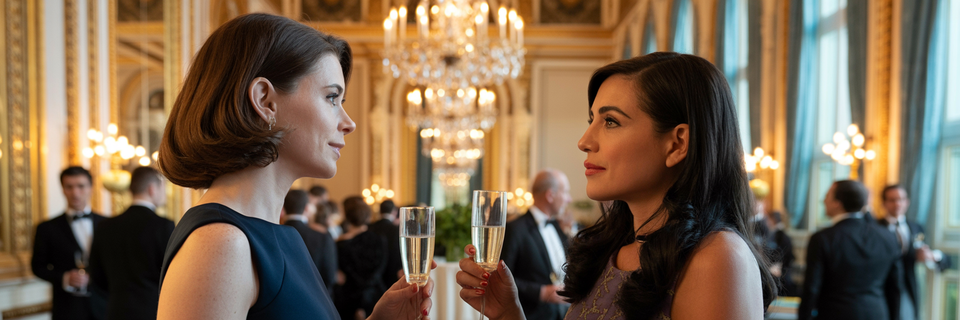
Evelyn remembered the first time she'd approached Naomi. It was three months ago, at the French Embassy, during a reception for the visiting trade delegation from Singapore. The reception was the kind of event that Evelyn could navigate in her sleep—crystal champagne flutes, polished marble, conversations that circled endlessly around policy without ever landing on principle. She had spotted Naomi near the powder room entrance, standing slightly apart from the crowd with the posture of a woman who was present in body and absent in every other dimension.
Naomi Reyes was forty-one years old, the wife of a man whose name appeared on government contracts with the regularity of a subscription. Her husband—Evelyn had never spoken his name within the Society, referring to him only as "the contractor"—was a construction executive who had pivoted from commercial real estate to government infrastructure with the opportunism of someone who understood that authoritarian regimes were, above all else, building projects. Roads, fences, detention facilities, surveillance installations. Power expressed itself through concrete, and Naomi's husband poured a great deal of concrete.
Naomi was slim, dark-haired, with the kind of beauty that in Washington was often mistaken for vacuity—an assumption she had learned to exploit. She spoke three languages, held a master's degree in international development from Johns Hopkins, and had spent five years working for USAID in Central America before her marriage had absorbed her career the way Thomas had absorbed Evelyn's. She was, in Evelyn's assessment, the most operationally capable woman in the Society, and she was being wasted as a decoration.
They had ended up in the powder room together—an encounter that Evelyn had engineered by timing her own visit to coincide with Naomi's. The powder room of the French Embassy was a small, elegant space: marble counters, gilt mirrors, a vase of white peonies that the Ambassador's wife refreshed daily. It was also, critically, one of the few rooms in the embassy that was not equipped with audio monitoring—a fact that Evelyn had confirmed through Isabelle Monclair.
Naomi had been standing at the mirror, reapplying lipstick with the mechanical precision of someone performing maintenance on a mask. She glanced at Evelyn in the reflection and offered the standard diplomatic-wife smile: warm, empty, forgettable.
"Beautiful reception," Evelyn said, settling beside her at the counter.
"Lovely," Naomi agreed. The word contained no enthusiasm whatsoever.
They stood in silence for a moment, two women in expensive dresses maintaining expensive surfaces. Then Naomi had set down her lipstick and spoken with a directness that Evelyn had not expected.
"My husband is building a stadium in Ohio," Naomi had said. Her voice was quiet but her eyes, in the mirror, were burning. "There are no exits."
Five words. There are no exits. Evelyn had heard many confessions in Washington—whispered grievances at cocktail parties, drunken admissions at dinner tables, the careful disclosures of people testing the boundaries of trust. But she had never heard anything as compressed and devastating as those five words. Naomi was not complaining about her husband's business. She was not expressing a vague political unease. She was telling Evelyn that her husband was building a prison, that it was designed to prevent escape, and that she knew exactly what it was for.
"They think we don't listen," Evelyn had whispered back. "They talk about Heritage targets over dinner the way they talk about golf scores. They leave classified documents on nightstands because they assume we can't read them. They plan the dismantling of civil society in rooms where we pour the coffee." She had held Naomi's gaze in the mirror. "We can recruit the people they don't see."
Naomi had been silent for a long time. Ten seconds, perhaps—an eternity in a conversation of this gravity. Evelyn had waited. She understood that what she was asking was not a small thing. She was asking Naomi to betray her husband, to risk her freedom, to step out of the role that Washington had assigned her and into a space where there were no rules and no safety nets. She was asking her to become, in the eyes of the law, a conspirator.
"When?" Naomi had said.
One word. And in that word, the Tuesday Literary Society had gained its logistics general.
In the weeks that followed, Naomi had proven herself indispensable. She brought not only intelligence—the blueprints for the Ohio facility, the transportation schedules for Heritage Unit personnel, the contractor network her husband used to build the infrastructure of detention—but an operational instinct that bordered on preternatural. She understood supply chains, logistics grids, and the movement of material and people with the fluency of someone who had spent years managing development projects in conflict zones. What USAID had trained her to do in Honduras and Guatemala—coordinate resources across hostile terrain with limited infrastructure and no margin for error—she now applied to the most complex domestic operation in American history.
It was Naomi who had identified Site 9—a decommissioned government facility in the Virginia countryside that had been mothballed after a budget cut and forgotten by the bureaucracy that owned it. She had verified its status through public records, confirmed its physical condition through a site visit disguised as a real estate appraisal, and secured access through a chain of intermediaries that included a sympathetic property manager and a forged authorization letter on General Services Administration letterhead. She had flipped the facility's skeleton crew—three maintenance workers and a security guard—by the simple method of telling them the truth: that the facility was being repurposed for a lawful action under the Emergency Stability Act, and that their cooperation was a matter of national security. She had not lied. She had merely deployed the truth selectively, which was, Evelyn reflected, the native language of Washington.
It was also Naomi who had organized the Iron Gate—a bar in the Adams Morgan neighborhood that served as the operational headquarters for the physical dimension of the plan. The bar was owned by a retired Marine named Luz Salgado, who had lost her restaurant to a Heritage Unit "compliance audit" and who had agreed to provide the back room as a tactical staging area with the quiet fury of someone who had been given a reason to fight. The Iron Gate's back room was swept for surveillance devices every morning, equipped with a Faraday cage that blocked electronic signals, and stocked with maps, radios, and the contingency plans that Naomi updated daily.
Over the next twelve weeks, the book club became a cell. They built a parallel chain of command, invisible and absolute. Evelyn was the coordinator—the hub through which all intelligence and operational decisions flowed. Naomi became the logistics architect, leveraging her husband's contacts and infrastructure to establish safe houses, transport routes, and the facility that would become Site 9. Elena Hale, who had been a member of the Society since its earliest days, revealed the scope of what she had been building from inside the White House—the relationship with Diego Soto, the mapping of the Residence's security systems, the connection to Aris Thorne. Commander Sarah Vance, recruited through her sister Chloe, brought the military dimension: the identification of sympathetic agents, the creation of the Blue Shield units, the tactical planning that would transform their intelligence into action.
The cell operated on principles that Evelyn had distilled from the very texts they had studied. Compartmentalization: no member knew the full scope of the operation, only the pieces relevant to their role. Deniability: every meeting had a legitimate cover, every communication was encrypted and ephemeral. Redundancy: critical functions were doubled, so that the loss of any single person would not collapse the structure. And above all, invisibility: they operated within the spaces that the regime had designated as insignificant—book clubs, powder rooms, service corridors, the domestic sphere that powerful men considered beneath their attention.
The recruitment continued. A White House calligrapher who had access to the Residence's scheduling system. A Pentagon secretary who processed Heritage Unit deployment orders. A caterer who worked state dinners and could move through security checkpoints without scrutiny. A retired federal judge named Diana Marsh who had been forced off the bench for ruling against the Emergency Stability Act and who could provide the legal framework for what they were planning. Each recruit was approached the same way—not with ideology or argument, but with a question that had no safe answer: What are you willing to live with?
The chain of command grew. The intelligence deepened. The plan took shape.
And now, lying in the dark at 11:45 PM on the night before the Fourth of July, Evelyn traced the chain from its origin to this moment. From a book club to a conspiracy. From Hilary Mantel to Hannah Arendt to a burner phone vibrating in a jewelry box. From twelve women reading novels in a Georgetown living room to a coordinated operation involving Secret Service commanders, former intelligence officers, White House staff, and a technology cell capable of impersonating the President of the United States.
She thought about the women who had said yes. Not the leaders—Elena, Naomi, Sarah, Aris—but the others. The calligrapher, the secretary, the caterer, the dozens of quiet, determined people who had looked at the country they lived in and decided that silence was no longer an option. They had no training for this. They had no mandate, no authority, no precedent. They had only the conviction that the system they were part of had failed, and that the people best positioned to repair it were the ones the system had made invisible.
Tonight, that chain was being pulled tight.
Every link was in position. Every signal was green. And Evelyn Ward, lying in the perfumed darkness of a bedroom that smelled of her husband's scotch and her own carefully maintained composure, felt the chain's tension in her chest like a second heartbeat.
She opened her eyes and stared at the ceiling. Thomas murmured something in his sleep—a fragment of a sentence, a ghost of a committee vote. She watched the shadows shift on the plaster and thought about what the morning would bring. Not the details—she knew the details, had rehearsed them until they were grooves in her mind—but the meaning. The meaning of what they were about to do. The meaning of a group of women who had been told their whole lives that their power was decorative, their knowledge was incidental, and their voices were background noise, standing up in the dark and saying: No. This is ours too. And we are taking it back.
The clock in the foyer struck midnight. The Fourth of July had begun.
Evelyn closed her eyes and breathed.
The silent gavel was falling.

Member discussion