Chapter 4: The Praetorian Shift
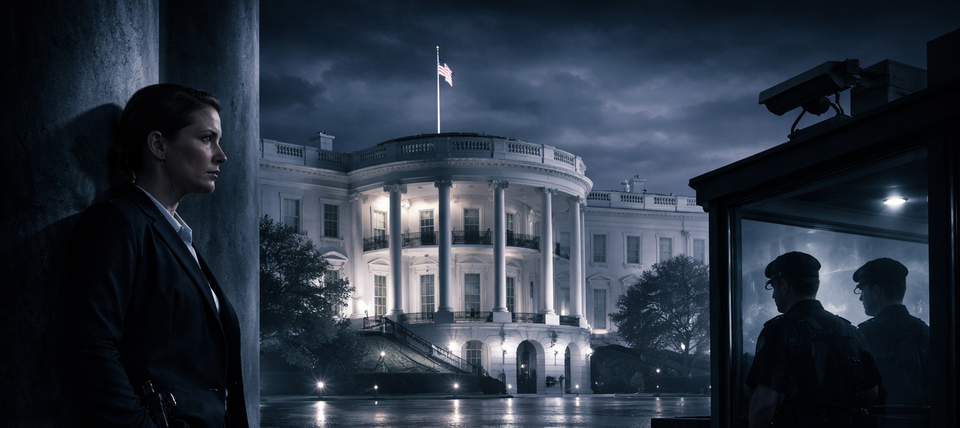
Commander Sarah Vance of the Secret Service stood in the shadows of the North Portico, her earpiece humming with the chatter of the night detail, and considered the geometry of betrayal.
The North Portico of the White House was a place of contradictions at this hour. During the day, it was the most photographed entrance in America—the columned facade that appeared on currency, in textbooks, on the evening news behind the shoulders of correspondents delivering reports that grew grimmer by the month. But at eleven o'clock on a July night, with the humidity pressing down like a lid and the grounds lit by the flat, institutional glow of perimeter security lamps, the Portico was something else entirely. It was a staging area. A checkpoint. The mouth of a system designed to control who entered and who left the most secure building on earth.
Sarah stood just inside the shadow cast by the eastern column, a position she had chosen with care. From here, she could see the main entrance, the guard station, and the approach from the East Wing without being visible to the security cameras mounted at the portico's roofline. The cameras were on a rotation—they swept in a predictable pattern that left a two-second blind spot at the eastern column every forty-five seconds. Sarah had timed this rotation seventeen times over the past three weeks, confirming the interval to the fraction of a second. Two seconds was enough to check her phone. Two seconds was enough to adjust the compact radio clipped to her belt. Two seconds was enough to be a person, rather than a position.
She was forty-four years old, and she had been in the Secret Service for nineteen of those years. She had joined at twenty-five, a year out of the Naval Academy, drawn to the Service by the same impulse that had drawn her to the military—a belief, sincere and almost naive in retrospect, that there were institutions worth protecting and that the people who protected them mattered. She had served on four presidential details. She had taken a bullet—not for a president, but for a diplomat, a Brazilian trade envoy who had been the target of a kidnapping attempt in Mexico City that had gone sideways in a way that still visited her in dreams. The scar was on her left shoulder, a puckered crescent that ached in cold weather and that she wore with the private, unsentimental pride of someone who understood the difference between courage and recklessness.
The Hale administration had changed everything.
Not immediately—authoritarian regimes rarely announced themselves with a single, clarifying moment. It had been incremental. The Heritage Loyalty Oath had been introduced in the second year, presented as a "voluntary reaffirmation of service" that all federal law enforcement personnel were "encouraged" to take. The language was patriotic, almost liturgical: "I affirm my loyalty to the principles of Heritage, to the stability of the Republic, and to the leadership of the duly elected President." It sounded like a pledge of allegiance with upgraded vocabulary. But within six months, agents who had not taken the oath found themselves reassigned to low-priority details—embassy security in secondary capitals, advance work for events that never materialized. Within a year, those who still refused were quietly terminated.
Sarah had taken the oath. She had stood in the East Room with forty other agents, raised her right hand, and spoken the words with the flat, empty delivery of someone reciting a grocery list. She had done it because refusing would have meant losing her position, and losing her position would have meant losing access. And access, she had already begun to understand, was the only currency that mattered.
The True Believers were different.
She watched them now through the tinted glass of the guard station—four agents on the overnight Residence detail, hand-picked by the President's personal security advisor for their ideological purity. They were younger than the agents Sarah had trained with, and they carried themselves differently. Where the old guard had been professional to the point of anonymity—the Secret Service ethic that your job was to be a shield, not a personality—the True Believers carried their assignment like a rank. They walked the corridors of the White House with the proprietary swagger of men who believed they were not just protecting the President but enforcing his vision. Their earpieces were tuned to a separate frequency—the Heritage channel, which carried the President's personal security directives and which, Sarah had discovered through months of careful observation, was not always consistent with the Service's standard protocols.
Agent Dalton was the one she worried about most. He was thirty-one, compact and intense, with the eyes of someone who slept with a weapon and dreamed about using it. He had been a Heritage Unit field operator before being transferred to the Secret Service—an unusual career path that reflected the Hale administration's systematic blurring of the line between law enforcement and ideological enforcement. Dalton didn't just follow orders; he believed in them. He believed in the Heritage Restoration Act. He believed in the Urban Purity Initiative. He believed that the Emergency Stability Act was the last line of defense between civilization and chaos. Sarah had heard him say, in the break room, that the protesters in the Northwest quadrant were "enemy combatants in civilian clothing" and that the Heritage Units should treat them accordingly.
Dalton was the True Believer that the term had been coined for. And in approximately two hours, Sarah was going to remove him from his post without violence, without detection, and without giving him any reason to suspect that the woman who outranked him was dismantling the security apparatus he had sworn to defend.
Her earpiece crackled.
"Vance." The voice was Captain Maya Jenkins, transmitted on a frequency that Chloe Vance had encrypted with a rotating cipher that changed every ninety seconds. Maya's voice was steady, clipped, military—the product of eight years in the Marines before she had joined the Blue Shield initiative, a clandestine rapid-response unit that the Tuesday Literary Society had assembled from retired and active-duty personnel who had refused the Heritage Loyalty Oath.
"The transport corridors are clear," Maya said. "Route Alpha from the Residence to the loading dock is unmonitored between 01:45 and 02:15—that's the maintenance crew's shift change. Route Beta through the East Wing is covered by Miller's feed, which Chloe has looped. The Blue Shield units are in position at the Navy Yard."
Sarah processed this information against the operational map she carried in her head—a three-dimensional model of the White House and its surrounding streets that she had spent nineteen years building and that she could navigate in the dark, which she soon would. Route Alpha was the primary extraction path. Route Beta was the fallback. If both were compromised, there was a Route Charlie that ran through the Rose Garden to an unmanned gate on the south perimeter, but Route Charlie required crossing open ground under surveillance, and Sarah had classified it as a last resort.
"How many at the Navy Yard?" Sarah asked.
"Two teams. Eight operators each. Armed with non-lethals—tasers, tranquilizer rounds, zip cuffs. We have two transport vehicles staged in the warehouse on M Street—unmarked, plates registered to a catering company that Naomi set up through three shell entities. Driver protocols are confirmed. Routes to Site 9 are mapped with two alternates."
"Copy," Sarah said. She processed the logistics with the part of her brain that had been trained to convert information into action without the interference of emotion. The other part—the part she kept on a short leash but could never entirely silence—thought about the human dimensions of what those numbers represented. Sixteen operators. People she had recruited, vetted, and trained over the past four months in sessions held at the Navy Yard after midnight, in a warehouse that Naomi Reyes had secured through a chain of leases so convoluted that even a forensic accountant would need a week to untangle it. She had looked each of them in the eye and asked the same question: "If you are ordered to do something unconstitutional, what do you do?" The answers had varied in their eloquence, but the core was always the same: you refuse. You refuse and you accept the consequences. That was the Blue Shield ethos, and it was the reason Sarah had given them a name at all—because a group with a name was a unit, and a unit could hold its ground.
"What's the status on the VP's estate?" Sarah asked.
"Perimeter established. Jenkins has two agents at the access road and two at the service entrance. Jammers are prepped—they'll go live when the fireworks start. The VP's personal detail is three agents, none Heritage-flagged. We don't anticipate resistance, but the containment protocol is ready if needed."
The Vice President. Arthur Graves—a man who had been selected for the ticket because he was pliable, photogenic, and spectacularly incurious about the details of governance. Sarah had met him twice, at official functions where he had shaken her hand with the grip of a man performing the act of handshaking rather than actually doing it. He was not dangerous. He was, however, a constitutional officer, and his isolation was a necessary component of the operation's first phase. If Graves learned what was happening before the communications loop was established, he could invoke the Twenty-Fifth Amendment, claim executive authority, and issue orders to the military that the Tuesday Literary Society would not be able to intercept. The VP had to remain ignorant, comfortable, and digitally severed from the chain of command until the operation was complete.
Sarah paused, listening to the ambient sound of the night detail through her standard earpiece. Dalton's voice was a low murmur, reporting positions with the bored efficiency of someone who believed the night was going to be uneventful. The other True Believers were doing the same—checking in, reporting clear, counting down the hours until their shift ended and they could return to whatever it was that True Believers did in their off hours. Sarah imagined it involved polishing their Heritage pins and reading the President's speeches as though they were scripture.
"The Residence detail is swapping now," Sarah said. "I have twelve agents ready to stand down."
Twelve agents. The number represented four months of work. Sarah had identified them one by one, approaching each with the caution of someone defusing a bomb—because that was essentially what she was doing. Each conversation had been a calculated risk. She had started with agents she knew personally, people she had trained with or served alongside on previous details, people whose body language in staff meetings told her that the Heritage Loyalty Oath sat uneasily on their tongues. She would find a moment—a quiet corridor, a post change, a ride in an elevator—and she would say something small. Not a recruitment pitch. Not a manifesto. Just a question. "How are you holding up?" Or: "What did you think about the executive order?" Or, most effectively: "What happens if we can't say no?"
The conversations that followed were always brief and always deniable. Sarah never asked anyone to commit to anything. She simply made herself available as a space where doubt could exist without consequence. And slowly, one by one, the agents had come to her. Some with anger. Some with fear. Some with the quiet, devastating exhaustion of people who had spent years serving a system they no longer recognized. Twelve agents who were willing to stand down when the moment came—not to fight, not to resist, but simply to step aside and allow something to happen that they could not, in conscience, prevent.
It was, Sarah reflected, a peculiar form of courage. The courage to do nothing. To be still while the world shifted around you. It was not the kind of courage that would be celebrated in the histories—if histories were still written honestly by the time this was over—but it was the kind that made the difference between a plan that worked and a plan that ended in bloodshed.
"No blood," Sarah said into the encrypted channel. It was the Tuesday Literary Society's operational mantra, and it was also, for Sarah, a personal covenant. She had seen blood. She had spilled it, in Mexico City and in a classified incident in Ankara that she would carry to her grave. She knew what violence cost, not just to the people it was done to but to the people who did it. The Hale administration dealt in violence as a matter of policy—Heritage Units, detention facilities, the quiet disappearances that the press had stopped reporting because the reporters who reported them had a tendency to disappear as well. The operation tonight would not add to that account. It would close it.
"No blood," Maya replied. The words crackled through the encrypted channel with the weight of a vow. "We're the cleaning crew."
Sarah allowed herself a small, tight smile—the first expression she had permitted herself in hours. The cleaning crew. It was Maya's term for the Blue Shield units, and it captured something essential about their mission. They were not conquerors. They were not revolutionaries. They were the people who came after the damage had been done to restore what the powerful had broken. Janitors with jurisdiction.
She checked the time. 11:31 PM. In two hours and twenty-nine minutes, the rotation would begin. Dalton and his True Believers would be relieved by Sarah's people—agents who had been briefed, who understood the stakes, and who would ensure that the corridors between the Residence and the extraction point were clear. The handoff would be routine in appearance: shift change, standard protocol, credential verification, post assignment. Dalton would walk away from his post without knowing that he was walking away from the last night of the regime he had sworn to protect.
The hardest part would be the four minutes after the swap. Four minutes during which Elena would move through the corridor, plant the repeater, and return. Four minutes during which any deviation—a restless president, a suspicious contractor, a camera glitch, an agent arriving early for the next rotation—could bring the entire operation down. Sarah had planned for seventeen contingencies. She had rehearsed response protocols for each one. She had positioned backup agents at three additional checkpoints along the extraction route. She had done everything that training and experience and sleepless determination could do.
And still, standing in the shadow of the North Portico on the night before the Fourth of July, Commander Sarah Vance felt the weight of what could not be planned for: luck. The random variable. The door that opens at the wrong moment, the phone that rings, the glance in the wrong direction. She had built her career on the principle that preparation could eliminate luck from the equation. Tonight, she was no longer certain that was true.
She shifted her weight, feeling the familiar press of the service weapon at her hip—a weapon she had carried for nineteen years and fired in the line of duty exactly twice. She hoped, with a ferocity that bordered on prayer, that tonight would not be the third time.
The North Portico was quiet. Inside, the True Believers paced their posts. In the Lincoln Bedroom, Elena waited with a device in her pocket. In Kalorama, Evelyn lay beside a man she was about to betray. In Alexandria, Aris watched screens that would soon carry the heartbeat of the most powerful man on earth. And at the Navy Yard, Maya Jenkins checked her tactical vest and confirmed that her teams were ready to move.
The machine was in position. Every gear, every spring, every tooth of the mechanism aligned and tensioned. In two hours, it would engage. And once it did, there would be no stopping it.
Sarah pressed her back against the cold stone of the column and settled in to wait. Patience was a professional requirement. It was also, tonight, a kind of faith—faith in the women who had built this machine, faith in the plan they had crafted, and faith in the belief that had sustained her through four years of watching the country she loved be dismantled by the man she was sworn to protect: that the oath she had taken was not to a person but to a principle, and that when the two diverged, the principle prevailed.
A sound reached her from inside the guard station—Dalton's laugh, sharp and brief, at something another agent had said. The laugh had an edge to it, the way everything about Dalton had an edge. She thought about what would happen to him after tonight. He would wake up in a different country—a country where the man he had worshipped was in custody and the women he had dismissed as background noise were running the government. She wondered if he would understand. She doubted it. True Believers rarely survived the loss of their truth. They either found another one or they shattered.
She would not feel sorry for him. She had spent too many nights reading the reports that crossed her desk—the Heritage Unit operation summaries, sanitized for internal consumption but still bearing the fingerprints of brutality. Detention statistics. Casualty figures categorized as "incident-related attrition." Photographs of facilities that looked like stadiums and functioned like prisons. Dalton had cheered for all of it. He had called it justice. Whatever happened to him after tonight was between him and whatever passed for his conscience.
The breeze shifted, carrying the faint scent of cut grass from the South Lawn and, beneath it, the mineral smell of the Potomac. Somewhere in the distance, a siren wailed and faded—the ordinary sound of a city that did not yet know it was on the edge of transformation.
The night was long. The humidity was relentless. And the Fourth of July was coming.

Member discussion